
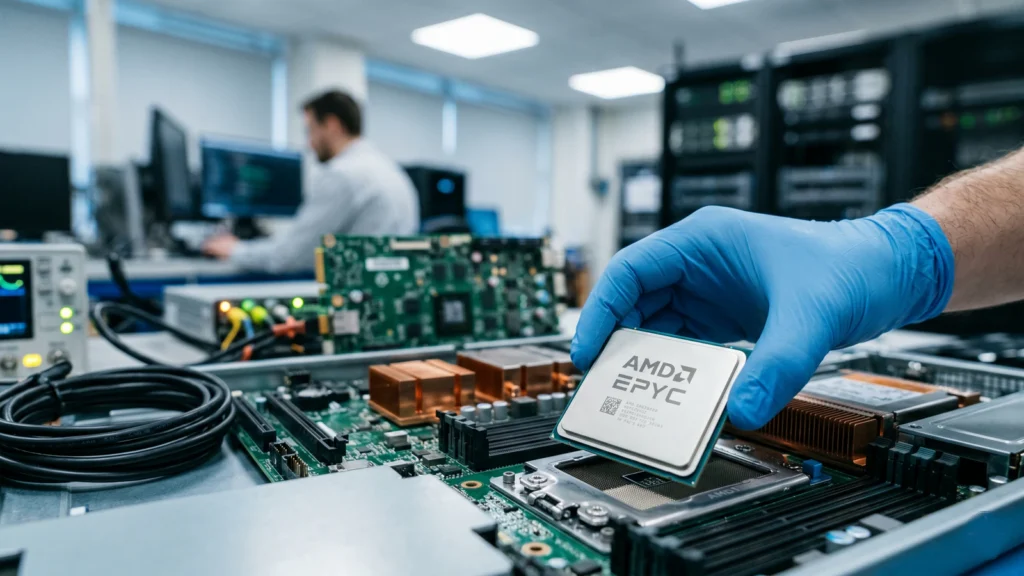
The semiconductor landscape of April 2026 is witnessing something the market hasn’t seen in two decades. Advanced Micro Devices (AMD) recently concluded an eleven-session winning streak, a vertical climb that has sent analysts scurrying to their history books. The last time the Santa Clara chipmaker saw this level of sustained, day-over-day positive momentum was May 2005—the era of the legendary Athlon 64.
However, unlike the desktop-driven gains of the mid-2000s, this 2026 rally is fueled by a different kind of fire: the global infrastructure shift toward yotta-scale AI and a massive 6-gigawatt strategic partnership with Meta. For investors watching the ticker, the question is no longer whether AMD can compete, but whether we are at the foot of a “structural re-rating” that could redefine the company’s valuation for the next decade.
The 2005 Parallel: From Challenger to Champion
To understand where AMD is going, we must look at where it was. In 2005, AMD was the “scrappy underdog” taking massive bites out of Intel’s server and desktop market share. The 12-day streak in May 2005 marked the moment Wall Street realized AMD’s architecture was fundamentally superior to the Pentium 4.
Fast forward to April 2026, and the narrative has shifted from CPUs to GPUs. While Nvidia dominated the initial AI explosion of 2023–2024, 2026 is becoming the year of the “credible second source.” With the launch of the Instinct MI450 series, AMD has moved past being a “budget alternative” and into the realm of a performance leader in specific, high-scale inference workloads.
The 6-Gigawatt Catalyst: The Meta Partnership
The primary driver of the current 10-day surge was the February 24 announcement of an expanded strategic partnership with Meta. This isn’t just a hardware purchase; it is a massive commitment to deploy 6 gigawatts of AI infrastructure powered by AMD’s “Helios” rack-scale architecture.
Meta’s move to diversify away from proprietary closed-loop systems in favor of AMD’s open ROCm software ecosystem is a signal to the entire enterprise world. When the largest social media company on the planet bets its next-gen AI future on your silicon, the market stops viewing you as an “also-ran.” The first gigawatt of this deployment is scheduled to ship in H2 2026, and the stock is currently “pricing in” that massive revenue realization early.
Engineering the Future: The 2nm Milestone
Technological superiority is the only true currency in semiconductors. At CES 2026, Lisa Su teased the MI500 series, but the current rally is centered on the MI450X—the industry’s first GPU to effectively leverage TSMC’s 2nm process technology.
By shrinking the node to 2nm, AMD has managed to achieve a 40% improvement in energy efficiency compared to the previous generation. In a world where power consumption is the greatest bottleneck to AI scaling, energy efficiency is more valuable than raw FLOPs. Hyperscalers are currently choosing the MI450 series not just because it’s cheaper than Nvidia’s “Vera Rubin” chips, but because they can fit more of them into existing power-constrained data centers.
The Silicon Rebound: Ryzen AI 400 and the PC Market
While data centers grab the headlines, the consumer side of the house is also firing on all cylinders. The Ryzen AI 400 series, which began shipping in early 2026, has captured a record 35% of the “AI PC” market. These chips, featuring a 60 TOPS NPU, have become the gold standard for local LLM processing in laptops.
The recovery of the PC market, which saw a 34% revenue jump year-over-year according to recent fiscal reports, has provided the cash flow necessary for AMD to keep its R&D spending aggressive. This “two-front war” against Intel in the PC space and Nvidia in the AI space is finally being won on both sides.
Technical Analysis: Breaking the $264 Ceiling
From a technical perspective, AMD is currently trading near $252.69, having surged nearly 30% in just two weeks. This puts the stock within striking distance of its all-time closing high of $264.33, set back in October 2025.
Unlike the speculative bubbles of the past, this rally is supported by a significant expansion in net income margins, which nearly doubled over the last 12 months. The P/E multiple has actually contracted from 105 to 75, suggesting that earnings growth is outpacing the stock price appreciation. For many institutional investors, this makes the current “all-time high” look like a value play rather than a peak.
Risks to the Bull Case
No investment is without headwinds. The “CUDA Moat” remains Nvidia’s strongest defense. While AMD’s ROCm software has made monumental leaps in 2025, many enterprise developers are still hesitant to migrate their legacy codebases away from Nvidia’s ecosystem. Furthermore, as we move into H2 2026, the global supply of HBM4 (High Bandwidth Memory) remains tight. Any hiccups in the supply chain could stall the delivery of the Helios racks, leading to a potential “miss” in Q3 or Q4 earnings.
Conclusion: A New Era for AMD
The comparisons to 2005 are apt because both periods represent a “re-rating” of what AMD is capable of. In 2005, AMD proved it could lead in server architecture. In 2026, AMD is proving it can sustain the world’s AI hunger.
As we look toward the second half of the year, the momentum seems fundamentally backed by orders, not just hype. With the Meta deal acting as a floor for revenue and the 2nm transition acting as a ceiling-breaker for performance, AMD’s 10-day winning streak may just be the opening act for a record-breaking fiscal year.
Frequently Asked Questions
Why is AMD stock rising so fast in 2026?
The surge is driven by a massive 6-gigawatt AI infrastructure partnership with Meta and the successful launch of 2nm-based Instinct GPUs.
How does the current AMD rally compare to 2005?
Both represent historic 10+ day winning streaks where AMD took significant technological leads over its primary competitors.
What is the price target for AMD stock after this streak?
Many analysts have revised targets toward the $311 mark, representing a projected 25% increase from current levels.
Is AMD taking market share from Nvidia?
Yes, AMD’s share of the AI accelerator market is expected to hit 7-10% in 2026, up from less than 1% three years ago.
What are the main risks for AMD investors right now?
Tight supply of HBM4 memory and Nvidia’s dominant CUDA software ecosystem remain the primary challenges for sustained growth.
Explore MORE ARTICLES