
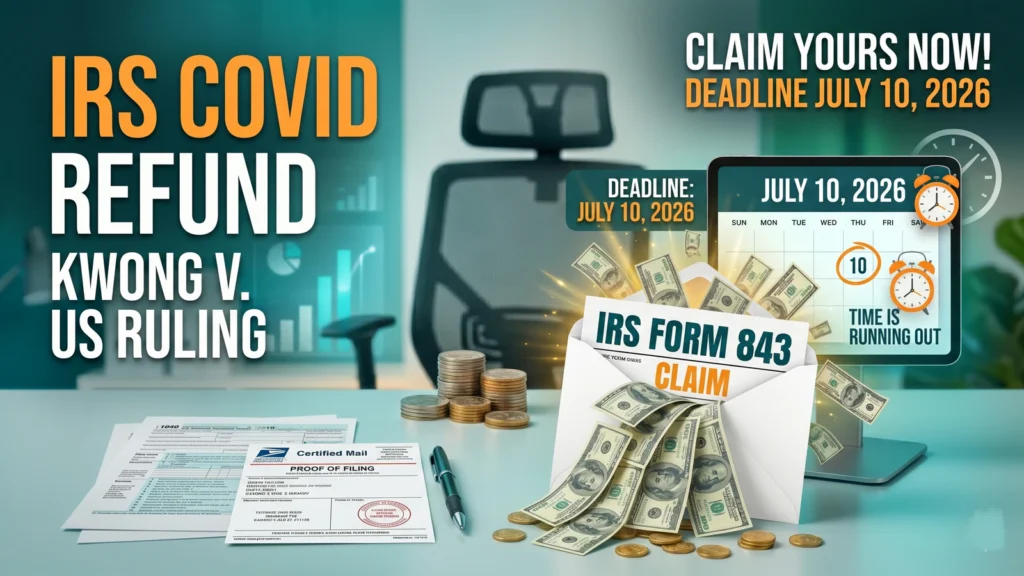
A recent landmark court ruling in the case of Kwong v. United States has opened a massive, yet little-known, window for tens of millions of taxpayers to reclaim money from the Internal Revenue Service (IRS). The court determined that the COVID-19 pandemic effectively paused federal tax deadlines from January 2020 through July 2023. This means that any penalties and interest assessed by the IRS for late filings or payments during this period were incorrectly applied.
Because this relief is not automatic, affected taxpayers must take proactive steps to claim their IRS COVID refund. With the deadline fast approaching, here is everything you need to know about your eligibility, the deadlines, and the exact steps required to secure your money.
The Origin of the Refund
During the COVID-19 pandemic, a federal disaster declaration was in effect from January 20, 2020, to May 11, 2023. Under Internal Revenue Code Section 7508A, disaster relief provisions legally pause tax penalties and interest for the duration of the disaster, plus an additional 60 days. The courts ruled that this extension legally pushed the “late” threshold to July 10, 2023.
If the IRS charged you late fees, failure-to-pay penalties, or accrued interest anytime during that three-and-a-half-year window, you overpaid. The National Taxpayer Advocate is now urging Americans to file “protective claims” to get that money back.
Who is Eligible for the COVID-Era IRS Refund?
Because COVID-19 was declared a nationwide disaster, the geographic scope of this relief covers virtually the entire United States. This issue is incredibly widespread and is not limited to a specialized group of taxpayers. You are likely eligible for a refund or a penalty abatement if you fall into any of the following categories:
- Individual Taxpayers: Everyday Americans who filed personal income tax returns late or paid taxes late during the pandemic and were hit with penalties.
- Small Business Owners & Gig Workers: Entrepreneurs and independent contractors who faced estimated tax penalties or delayed filings due to pandemic disruptions and lockdowns.
- Large Corporations: Businesses that incurred substantial late-payment interest on corporate tax obligations.
- Trusts, Estates, and Nonprofits: Fiduciaries and tax-exempt organizations that were penalized for delayed tax actions, including employment, gift, and excise taxes during the disaster window.
Qualifying Charges Include:
- Failure-to-File (FTF) Penalties: Assessed when a return is submitted past the traditional deadline.
- Failure-to-Pay (FTP) Penalties: Assessed when a tax balance is not paid in full by the original due date.
- Underpayment of Estimated Tax Penalties: Charged to businesses or gig workers who missed quarterly tax payments.
- Underpayment Interest: Any interest that accrued on unpaid taxes or penalties during the disaster period (Jan 20, 2020 – July 10, 2023).
Why the Deadline is Strictly Set for July 10, 2026
In tax law, refund claims are governed by strict statutes of limitations. Generally, under IRC Section 6511, a taxpayer has three years from the filing deadline or two years from the date the tax was paid to request a refund.
Because the Kwong decision treats the COVID-19 period as extending federal tax deadlines through July 10, 2023, the three-year statutory clock began ticking on that exact date. Therefore, the absolute final day for the vast majority of taxpayers to submit their refund claims is July 10, 2026.
Erin Collins, the National Taxpayer Advocate, recently emphasized the urgency of this date. If taxpayers do not have their paperwork submitted by July 10, 2026, they will permanently forfeit their right to recover these funds, regardless of whether a higher court eventually upholds the Kwong decision.
Step-by-Step: How to Claim Your Refund
The IRS relies heavily on paper processing for these types of retroactive adjustments. You cannot simply log into an IRS portal and click a button to request this money back. Follow these exact steps to ensure your claim is valid, properly formatted, and legally protected:
Step 1: Obtain Your IRS Transcripts
Do not guess how much you were penalized. Before filing anything, go to IRS.gov and download your official IRS account transcripts for the tax years 2019, 2020, 2021, 2022, and 2023. Review these documents carefully and highlight any penalty or interest entries.
Step 2: Map the Accrual Dates
Look closely at the dates associated with the highlighted charges. You are looking for any penalties or interest that accrued between January 20, 2020, and July 10, 2023. Even if the original tax liability originated before the pandemic, the portion of the interest that compounded during the disaster window may still be eligible for a refund.
Step 3: Fill Out Form 843
You must manually complete IRS Form 843 (Claim for Refund and Request for Abatement). Fill in your personal or business details, the specific tax periods in question, and the exact dollar amounts you are requesting to be refunded. If you have not yet paid the penalty but it is sitting on your account as an outstanding balance, you will use this same form to request an “abatement” (legal cancellation) of the debt.
Step 4: Add the Required Legal Language
Because this is a protective claim tied to ongoing litigation, your Form 843 must clearly state its purpose. As recommended by the Internal Revenue Manual (IRM) procedures for protective claims, write the following phrase clearly across the very top margin of the form:
“Protective Refund Claim Pursuant to Kwong Case”
Additionally, include a concise statement in the explanation section of the form citing Internal Revenue Code Section 7508A(d) and the Kwong v. United States decision, referencing the specific dates of the COVID disaster period.
Step 5: Mail via Certified Mail
Do not send this form via standard mail or drop it in a standard post office box. The IRS faces notorious backlogs with paper forms, and lost mail is a common occurrence. Mail your completed Form 843, along with copies of your supporting transcripts, via USPS Certified Mail with a Return Receipt. This provides you with an irrefutable, timestamped tracking number proving that you met the July 10, 2026, deadline.
Key Details at a Glance
| Feature | Legal/Procedural Details |
| Relevant Court Case | Kwong v. United States (U.S. Court of Federal Claims, Nov 2025) |
| Governing Tax Code | Internal Revenue Code (IRC) Section 7508A(d) |
| Federal Disaster Period | January 20, 2020 – May 11, 2023 |
| Penalty-Free Window Extended To | July 10, 2023 (Disaster end date + 60 days) |
| Required IRS Form | Form 843 (Claim for Refund and Request for Abatement) |
| Filing Deadline | July 10, 2026 (For the vast majority of taxpayers) |
| Eligible Entities | Individuals, Corporations, Small Businesses, Estates, Trusts, Nonprofits |
| Eligible Charges | Failure-to-File, Failure-to-Pay, Estimated Tax Penalties, Underpayment Interest |
| Recommended Submission Method | USPS Certified Mail with Return Receipt (Paper filing is strictly required) |
Frequently Asked Questions
What is this refund for?
It is to recover IRS penalties and interest that were incorrectly charged for late filings or payments during the COVID-19 disaster period.
Is this a new COVID-19 stimulus check?
No, this is strictly a refund of specific penalties and interest you already paid to the IRS between 2020 and 2023.
Do I need to file a claim if I haven’t paid the penalties yet?
Yes, you can file a protective claim requesting an “abatement” so the IRS officially drops the outstanding charges.
Can I file this claim electronically?
No, the IRS currently requires Form 843 to be submitted physically through the mail as a paper document.
What happens if I miss the deadline?
If you do not have your Form 843 postmarked by July 10, 2026, you will permanently lose your legal right to claim this money.
Explore MORE ARTICLES