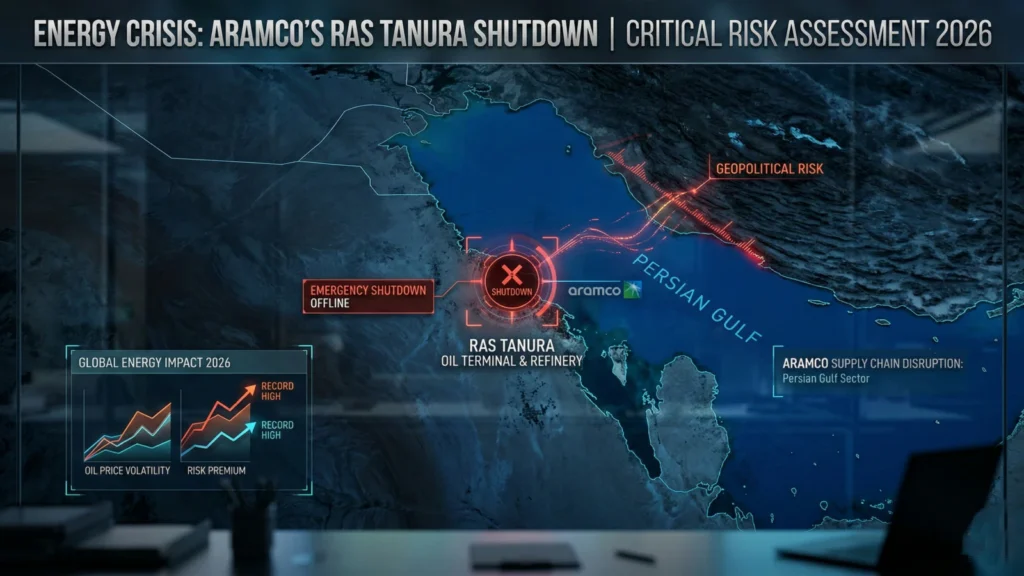
The global energy landscape shifted violently this morning. In a dawn raid that has sent shockwaves from Riyadh to Wall Street, Saudi Aramco’s massive Ras Tanura refinery—the heart of the Kingdom’s oil export infrastructure—was forced into an emergency shutdown following a sophisticated drone strike.
As of March 2, 2026, the geopolitical “risk premium” is no longer a theoretical calculation for analysts; it is a lived reality for every consumer at the pump. With crude prices surging and the Trump administration signaling a “maximum response” posture, the impact on Aramco, Ras Tanura, and the global oil supply chain is unprecedented.
The Strike at the Heart: Ras Tanura Under Fire
Ras Tanura is not just another refinery. It is the world’s largest crude oil terminal and a critical node in the global energy web, capable of processing over 550,000 barrels per day. Located on the Persian Gulf coast, it serves as the primary gateway for Saudi crude heading to markets in Asia and Europe.
According to initial reports from Reuters, the drone strike targeted the refinery’s stabilization towers—highly sensitive infrastructure that, if damaged long-term, could bottleneck Saudi Arabia’s ability to export its “Arab Light” crude. While Aramco has officially stated that fire suppression systems were activated immediately, the decision to halt operations at the facility signals a significant breach in the regional security umbrella.
Aramco’s Response: Stability vs. Reality
For Aramco, the timing of this attack is particularly sensitive. The company has spent the last two years Diversifying into blue hydrogen and expanding its downstream capabilities. However, a total shutdown at Ras Tanura reminds investors that despite the energy transition, the world’s most profitable company remains anchored to the volatile geopolitics of the Middle East.
Internal sources suggest that Aramco is currently rerouting supply through its “East-West Pipeline” to Yanbu on the Red Sea. While this provides a temporary buffer, the logistics of shifting hundreds of thousands of barrels of oil overnight are fraught with difficulty and increased shipping costs.
Geopolitical Fallout: The Trump Factor and the Iran Pivot
The market reaction was instantaneous, but the political reaction has been even more explosive. CNBC reports that President Trump has already convened an emergency meeting of the National Security Council. The administration’s rhetoric has pivoted sharply toward Iran, with the White House suggesting that the drones utilized “advanced components” linked directly to Tehran-backed militias.
The “Trump Trade” in the energy sector is currently seeing a massive flight to safety. Gold and oil are moving in tandem, as the threat of a direct U.S.-Iran escalation looms larger than it has at any point in the 2020s. For the first time in years, the phrase “Supply Chain Decoupling” is being applied to Middle Eastern energy, as Western powers scramble to secure North Sea and Permian Basin alternatives.
Market Impact: Why Oil Prices Are Breaking Records
The immediate impact on oil prices saw Brent Crude leap past the $115 mark within hours of the Ras Tanura news. Analysts are now looking at several critical factors that could push prices even higher:
- Inventory Depletion: Global oil inventories were already at a 5-year low heading into March 2026. This disruption leaves zero margin for error.
- Insurance Premiums: Maritime insurance for tankers operating in the Persian Gulf is expected to quadruple by the end of the week.
- The China Factor: As the world’s largest importer of Saudi crude, China’s reaction to the Aramco disruption will be pivotal. Any sign of Beijing “panic-buying” will send prices into a vertical climb.
The Long-Term Outlook for Global Energy Security
This event is a wake-up call for the global economy. The reliance on centralized hubs like Ras Tanura makes the entire world vulnerable to low-cost, high-impact drone technology. Even if Aramco restores partial operations within 72 hours, the psychological damage is done.
The 2026 oil market is no longer defined by supply and demand alone; it is defined by the resilience of the infrastructure. As nations look at the smoking ruins of stabilization units at Ras Tanura, the push for energy independence—whether through domestic fossil fuels or rapid-scale renewables—is no longer an environmental goal; it is a national security mandate.
Frequently Asked Questions
Why is Ras Tanura so important to global oil prices?
A: It is the world’s largest oil terminal and a primary export hub for Saudi Aramco’s global supply.
How did the drone strike bypass Aramco’s security?
Reports suggest a “swarm” tactic was used, overwhelming local air defense systems with low-altitude, high-frequency targets.
Will oil prices go down soon?
Prices are likely to remain elevated until Aramco confirms a full restoration of Ras Tanura and geopolitical tensions with Iran ease.
Is there an immediate oil shortage in the US?
No, the US relies heavily on domestic production, but global price surges will still affect local gas prices.
What is the Trump administration’s stance on the Aramco attack?
The administration has signaled a “maximum response” posture, blaming Iran-backed actors for the regional instability.
Explore MORE ARTICLES