Washington, Feb 21, 2026 — President Donald Trump has intensified his trade agenda by announcing a sharp increase in global tariffs, raising the rate from 10% to 15% just one day after unveiling the initial levy. The decision, revealed through a post on his Truth Social platform, came in direct defiance of a U.S. Supreme Court ruling that limited his emergency authority to impose sweeping tariffs.
The move underscores Trump’s determination to reshape international trade rules despite legal challenges, signaling that he intends to push forward with aggressive measures even when confronted by constitutional limits.
The Announcement
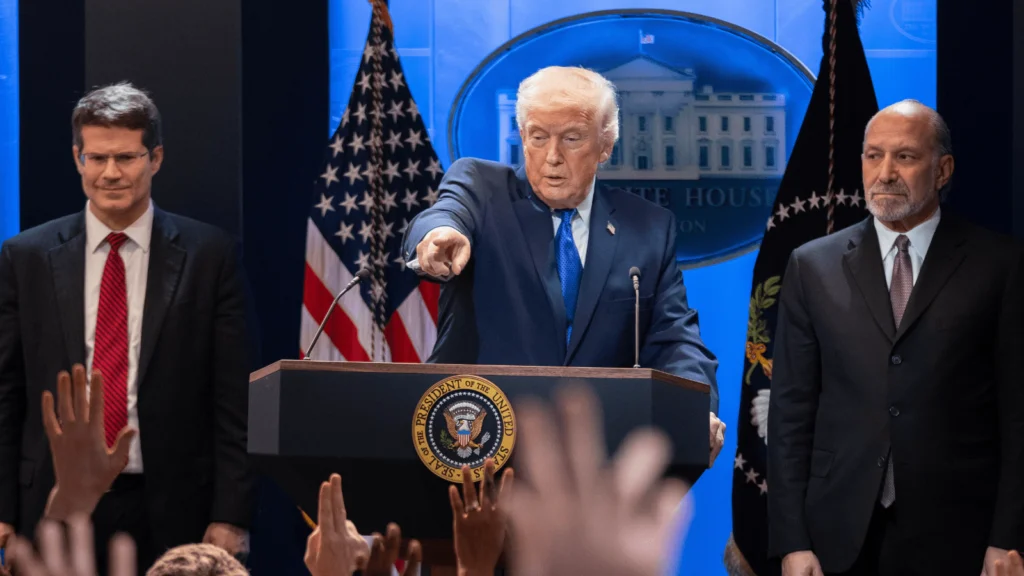
On Saturday, Trump declared that the newly imposed 10% tariff on imports worldwide would be raised to 15% “effective immediately.” His statement followed what he described as a “thorough, detailed, and complete review” of the Supreme Court’s decision, which he criticized as “ridiculous, poorly written, and extraordinarily anti-American.”
Trump argued that many countries had taken advantage of the United States for decades without facing consequences. He framed the tariff increase as a corrective measure, insisting that the higher rate was “fully allowed and legally tested.”
Background: The Supreme Court Setback
The escalation came just a day after the Supreme Court ruled that the president does not hold unilateral emergency powers to impose broad tariffs. The majority opinion, authored by Chief Justice John Roberts, emphasized that the Constitution clearly grants taxing authority—including tariffs—to Congress.
“The Framers did not vest any part of the taxing power in the Executive Branch,” Roberts wrote, underscoring the separation of powers.
Despite the ruling, Trump signed an executive order late Friday authorizing a 10% tariff on imports across the globe. Under the order, those tariffs would remain in effect for 150 days unless extended by Congress. The following day, he raised the rate to 15%, challenging the court’s interpretation and asserting his administration’s authority to act.
Trump’s Justification
In his Truth Social post, Trump insisted that the tariff increase was necessary to protect American industries and workers. He claimed that foreign nations had “ripped off” the United States for years, and that his administration was finally holding them accountable.
He also suggested that additional tariffs would be announced in the coming months, promising that they would be “legally permissible” and part of his broader effort to strengthen the U.S. economy. “This will continue our extraordinarily successful process of Making America Great Again – GREATER THAN EVER BEFORE!!!” Trump wrote.
The Court’s Dissent
While the majority of justices sided against Trump, three conservative members of the court dissented. Justice Brett Kavanaugh, joined by Justices Samuel Alito and Clarence Thomas, argued that the tariffs were lawful under constitutional precedent.
“The tariffs at issue here may or may not be wise policy. But as a matter of text, history, and precedent, they are clearly lawful,” Kavanaugh wrote in his dissenting opinion.
This division within the court highlights the ongoing debate over the scope of presidential power in trade policy and the balance between executive authority and congressional oversight.
Implications for Global Trade
The sudden increase from 10% to 15% is expected to have significant consequences for international markets. Economists warn that higher tariffs could trigger retaliatory measures from trading partners, potentially escalating into broader trade disputes.
For U.S. businesses, the impact will vary. Companies reliant on imported goods may face higher costs, while domestic producers could benefit from reduced competition. In the financial sector, analysts anticipate heightened volatility as markets react to the uncertainty surrounding U.S. trade policy.
Political Context
Trump’s decision comes at a politically charged moment, as he continues to position himself as a defender of American workers against what he portrays as unfair global trade practices. The announcement also reflects his willingness to challenge institutional limits, even in the face of judicial rulings.
By raising tariffs immediately after the Supreme Court’s decision, Trump has signaled that he is prepared to test the boundaries of executive power. His critics argue that such actions undermine constitutional checks and balances, while supporters see them as evidence of his commitment to protecting U.S. interests.
Looking Ahead
The administration has indicated that further tariff measures will be introduced in the coming months. These new policies are expected to be crafted in ways that comply with legal requirements, though the details remain unclear.
Observers note that the confrontation between Trump and the Supreme Court could set the stage for a broader constitutional debate over trade authority. Congress may also be forced to weigh in, given its constitutional role in taxation and tariffs.
Conclusion
President Trump’s decision to raise global tariffs to 15% marks a dramatic escalation in his trade strategy, coming just one day after the Supreme Court sought to limit his emergency powers. The move highlights his determination to reshape global trade rules, even in the face of legal and political obstacles.
With dissenting voices on the court and growing concerns among economists, the announcement sets the stage for a contentious period in U.S. trade policy. Whether the higher tariffs will achieve Trump’s stated goal of protecting American industries—or spark retaliatory measures abroad—remains to be seen.
Explore MORE ARTICLES