
Inflation is the rate at which the general level of prices for goods and services rises over time, reducing the purchasing power of money. In simple terms, when inflation occurs, each dollar buys fewer goods and services than before.
Why Inflation Exists in Modern Economies
Global influences: Supply chain disruptions, energy prices, and geopolitical events often add pressure.
Demand-pull inflation: When demand for goods and services exceeds supply.
Cost-push inflation: When production costs (like wages or raw materials) rise, pushing prices higher.
Monetary factors: Central banks increasing money supply can also fuel inflation.
Difference Between Inflation and Price Volatility
- Inflation: A broad, long-term rise in overall prices across the economy.
- Price volatility: Short-term fluctuations in specific items (like oil or vegetables) due to temporary supply or demand shocks.
- Key distinction: Inflation is systemic and persistent, while volatility is localized and temporary.
How Inflation Is Measured
Economists and policymakers track inflation using price indices:
- Consumer Price Index (CPI): Measures the average change in prices paid by households for a basket of goods and services.
- Personal Consumption Expenditures (PCE): Broader measure used by the U.S. Federal Reserve, capturing changes in consumer spending patterns.
- Both indices provide a percentage rate (e.g., 3% annual inflation), showing how much prices have risen compared to the previous year.
Example
Imagine a basket of goods that includes groceries, rent, and transportation:
- Year 1: Basket costs $100.
- Year 2: Basket costs $103.
- Inflation rate = .
This means your $100 savings from last year can no longer buy the same basket of goods—it now costs $103.
Inflation is more than just rising prices—it’s a persistent erosion of purchasing power. Understanding how it’s measured and distinguished from short-term volatility helps individuals and businesses plan for the future.
Why Do Prices Keep Rising?
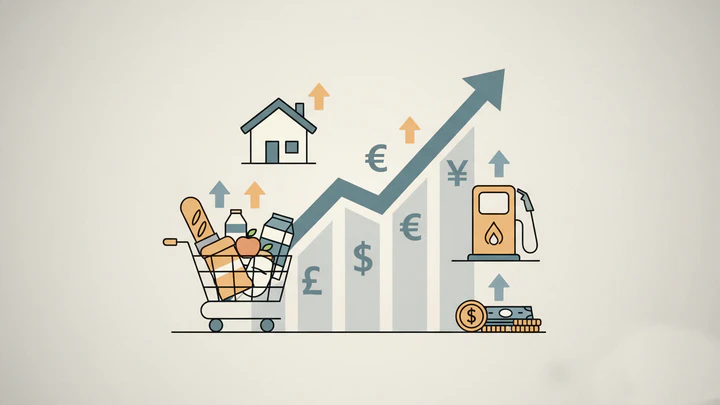
Inflation doesn’t happen by accident—it results from a mix of economic forces that push prices upward. Understanding these drivers helps explain why your money buys less over time.
Demand-Pull Inflation
- Excess demand relative to supply: When consumers and businesses spend more than the economy can produce, prices rise.
- Economic growth & consumer spending: In periods of strong growth, households have higher incomes and spend more, creating upward pressure on prices.
- Example: If demand for housing surges but construction lags, rents and home prices climb.
Cost-Push Inflation
- Rising input costs: Higher wages, energy prices, or raw material costs increase production expenses.
- Supply chain pressures: Disruptions in logistics or shortages of key inputs (like semiconductors) push costs higher.
- Producer price transmission: Businesses pass these higher costs to consumers in the form of price increases.
- Example: A spike in oil prices raises transportation costs, which then makes groceries more expensive.
Monetary Factors
- Money supply expansion: When central banks inject more money into the economy, too much liquidity can chase too few goods.
- Role of central banks: Interest rate policies directly influence borrowing, spending, and inflation.
- Example: If the Federal Reserve keeps rates too low for too long, cheap credit fuels demand and price increases.
Structural and Global Factors
- Globalization vs. deglobalization: Global trade once kept prices low, but supply chain reshoring or trade barriers can raise costs.
- Supply shocks: Natural disasters, pandemics, or geopolitical conflicts disrupt production and logistics.
- Geopolitics: Wars or sanctions can restrict access to commodities, driving global price spikes.
- Example: A geopolitical conflict that disrupts grain exports can raise food prices worldwide.
Inflation is rarely caused by just one factor—it’s the interplay of demand, costs, monetary policy, and global events. Recognizing these drivers helps individuals and policymakers anticipate risks and plan accordingly.
How Inflation Is Measured
Inflation isn’t just a vague concept—it’s tracked carefully using standardized indices that measure how prices change over time. These measures help policymakers, businesses, and households understand the pace of inflation and make informed decisions.
Consumer Price Index (CPI)
- What CPI Represents: The CPI measures the average change in prices paid by consumers for a fixed “basket of goods and services.”
- Basket of Goods Construction:
- Includes everyday items like food, housing, clothing, transportation, healthcare, and recreation.
- Weighted according to household spending patterns (e.g., housing has a larger weight than entertainment).
- Usage: CPI is the most widely cited measure of inflation in the U.S. and is often used to adjust wages, pensions, and contracts.
Core Inflation vs. Headline Inflation
- Headline Inflation: Includes all items in the CPI basket, including volatile categories like food and energy.
- Core Inflation: Excludes food and energy prices to provide a clearer view of underlying inflation trends.
- Why Policymakers Focus on Core: Food and energy prices can swing sharply due to weather or geopolitics, so core inflation gives a more stable signal for long-term monetary policy decisions.
Limitations of Inflation Measures
- Substitution Bias: CPI assumes consumers buy the same basket each year, but in reality, people switch to cheaper alternatives when prices rise.
- Regional Variation: Inflation can differ across regions—urban vs. rural areas may experience different price pressures.
- Asset Price Inflation vs. Consumer Inflation: CPI and PCE track consumer goods and services, but they don’t capture rising asset prices (like housing, stocks, or real estate), which also affect household wealth.
Inflation measurement is essential but imperfect. While CPI and PCE provide valuable insights, they don’t capture every nuance of how rising prices affect consumers. That’s why analysts often look at multiple measures and consider both headline and core inflation to get the full picture.
How Inflation Affects Your Savings
Inflation doesn’t just raise the cost of groceries or rent—it directly impacts your savings and investments by eroding the real value of money over time.
Inflation vs. Nominal Returns
- Nominal return: The stated return on your savings or investment (e.g., a savings account paying 4% interest).
- Real return: The return after adjusting for inflation.
- Formula:
- Example: If your savings account earns 4% interest but inflation is 6%, your real return is –2%, meaning your money is losing purchasing power.
Erosion of Purchasing Power
- Fixed deposit / savings account: Suppose you deposit $10,000 in a bank account earning 3% interest.
- After one year, you have $10,300.
- But if inflation is 5%, the basket of goods that cost $10,000 last year now costs $10,500.
- Result: Your savings grew in nominal terms, but in real terms, you can buy less than before.
Inflation Risk for Long-Term Savers
- Retirement savings: Over decades, even moderate inflation (2–3% annually) can erode the real value of retirement funds. A nest egg of $1 million today may only have the purchasing power of $600,000 in 20 years if inflation averages 2%.
- Long-duration goals: Education, home purchases, or healthcare costs often rise faster than general inflation. Without inflation-adjusted planning, savers may find themselves short of funds when those expenses arrive.
- Key insight: Long-term savers must invest in assets that outpace inflation (e.g., equities, inflation-protected bonds, or real estate) rather than relying solely on low-yield savings accounts.
Inflation silently eats away at savings. To protect wealth, individuals must focus on real returns, understand how purchasing power erodes, and plan long-term goals with inflation-adjusted strategies.
Inflation’s Double-Edged Sword
Interestingly, inflation isn’t always bad. Economists often argue that moderate inflation is healthy for an economy.
- Pros:
- Encourages spending and investment (people don’t hoard cash).
- Helps borrowers, since debts shrink in real value over time.
- Signals economic growth when demand is strong.
- Cons:
- Hurts savers if returns don’t keep pace.
- Reduces affordability for essentials.
- Creates uncertainty in long-term planning.
Who Benefits and Who Loses From Inflation
Inflation doesn’t affect everyone equally—it redistributes wealth and purchasing power across different groups. Some benefit, while others lose out.
Borrowers vs. Savers
- Borrowers benefit:
- The real value of debt declines with inflation.
- Example: If you owe $100,000 on a fixed-rate mortgage, inflation erodes the real burden of repayment because future dollars are worth less.
- Savers lose:
- Fixed-income savers (bank deposits, bonds with low yields) see their purchasing power shrink.
- Example: A savings account earning 2% interest loses real value if inflation runs at 4%.
Wage Earners
- Wage growth lag vs. inflation: Salaries often adjust more slowly than prices.
- Real income compression: Even if nominal wages rise, if inflation rises faster, workers’ real income falls.
- Example: A worker’s salary increases by 3%, but inflation is 5%—their real income effectively declines by 2%.
Asset Owners
- Real assets benefit: Owners of property, commodities, or equities often see asset values rise with inflation.
- Cash holders lose: Holding large amounts of cash erodes wealth as purchasing power declines.
- Uneven distributional effects: Wealthier households with investments in real estate or stocks may benefit, while lower-income households relying on cash savings suffer.
Inflation creates winners and losers. Borrowers and asset owners often gain, while savers and wage earners lose if their returns or incomes don’t keep pace. The uneven distribution highlights why inflation is both an economic and social issue—it reshapes wealth across society.
Real-World Example: How Inflation Impacts Savings Over 10 Years
Inflation gradually erodes the real value of savings, especially when interest earned is lower than inflation. Let’s look at a simple hypothetical example to see how this plays out over a decade.
Hypothetical Scenario
- Initial savings: $10,000
- Savings account interest rate: 2% per year
- Inflation rate: 3% per year
Step-by-Step Impact
- Nominal growth: Your savings account balance grows at 2% annually.
- Real value erosion: Inflation rises at 3% annually, meaning the purchasing power of your savings declines.
Table: Savings vs. Inflation Over 10 Years
| Year | Savings Balance (Nominal, $) | Inflation-Adjusted Value (Real, $) |
|---|---|---|
| 0 | 10,000 | 10,000 |
| 1 | 10,200 | 9,902 |
| 2 | 10,404 | 9,805 |
| 3 | 10,612 | 9,709 |
| 4 | 10,824 | 9,614 |
| 5 | 11,041 | 9,520 |
| 6 | 11,262 | 9,427 |
| 7 | 11,487 | 9,335 |
| 8 | 11,716 | 9,244 |
| 9 | 11,950 | 9,154 |
| 10 | 12,189 | 9,065 |
Observation
- After 10 years, your account shows $12,189 (nominal).
- But in real terms, adjusted for inflation, it’s worth only $9,065 in purchasing power.
- That’s a loss of nearly $3,100 in real value compared to the starting point.
Even though savings accounts grow in nominal terms, inflation can silently erode purchasing power over time. This highlights the importance of investing in assets that outpace inflation (like equities, real estate, or inflation-indexed bonds) rather than relying solely on low-yield savings.
How Central Banks Try to Control Inflation
Central banks—like the U.S. Federal Reserve or the Reserve Bank of India—play a critical role in managing inflation. Their policies aim to balance price stability with economic growth, but the tools they use often come with trade-offs.
Role of Interest Rates
- Raising rates: Makes borrowing more expensive, slowing consumer spending and business investment. This reduces demand and helps cool inflation.
- Lowering rates: Makes credit cheaper, encouraging spending and investment, which can stimulate growth but also risk higher inflation.
- Key mechanism: Interest rates influence everything from mortgages and car loans to corporate financing.
Monetary Tightening vs. Easing
- Monetary tightening:
- Higher interest rates, reduced money supply.
- Goal: Slow down demand and bring inflation under control.
- Monetary easing:
- Lower interest rates, increased liquidity.
- Goal: Stimulate growth during recessions or low-inflation periods.
- Balance: Central banks must decide whether inflation or growth is the bigger risk at any given time.
Trade-Offs Between Inflation Control and Growth
- Inflation control: Tightening policies can stabilize prices but risk slowing the economy and raising unemployment.
- Growth support: Easing policies boost demand but risk overheating the economy and fueling inflation.
- Delicate balance: Policymakers aim for a “Goldilocks zone”—moderate inflation with steady growth.
Lag Effects of Monetary Policy
- Delayed impact: Changes in interest rates don’t affect inflation immediately. It can take 12–18 months for policy shifts to fully ripple through the economy.
- Transmission channels: Rate changes influence borrowing, spending, investment, and eventually prices.
- Challenge: Central banks must act proactively, often tightening before inflation peaks or easing before growth slows too much.
Central banks use interest rates and monetary policy as their primary tools to manage inflation. But because of trade-offs and lag effects, their decisions require foresight and discipline. The art of inflation control lies in balancing price stability with sustainable economic growth.
Inflation Around the World
Inflation isn’t uniform—it varies by country and time period.
- Hyperinflation: In Zimbabwe during the late 2000s, prices doubled almost daily. People carried bags of cash just to buy bread.
- Deflation: Japan experienced periods where prices fell, discouraging spending and slowing growth.
- Moderate Inflation: In the U.S. and Europe, central banks aim for around 2% inflation annually, considered “healthy.”
Inflation vs. Deflation vs. Disinflation
Inflation is only one side of the price movement story. Economies can also experience deflation or disinflation, each with very different implications for growth, savings, and investment.
Clear Definitions
- Inflation: A sustained rise in the general price level of goods and services.
- Deflation: A sustained decline in the general price level, meaning money gains purchasing power over time.
- Disinflation: A slowdown in the rate of inflation—prices are still rising, but at a slower pace.
Why Mild Inflation Is Preferred to Deflation
- Economists generally view moderate inflation (2–3% annually) as healthy.
- It encourages spending and investment rather than hoarding cash.
- Deflation, by contrast, discourages consumption—people delay purchases expecting lower prices later, which can stall economic activity.
Economic Risks of Deflationary Cycles
- Falling demand: Consumers and businesses cut spending, leading to lower production.
- Debt burden rises: The real value of debt increases, making repayment harder for borrowers.
- Unemployment risk: Companies reduce output and jobs as revenues shrink.
- Historical example: The Great Depression of the 1930s was marked by severe deflation, worsening economic collapse.
What “Disinflation” Actually Means
- Disinflation is not deflation—prices are still increasing, just at a slower pace.
- Example: Inflation falls from 6% to 4%—this is disinflation.
- Policymakers often aim for disinflation when inflation is too high, using interest rate hikes or tighter monetary policy.
- It signals progress toward stability without the damaging effects of outright deflation.
Takeaway:
- Inflation erodes purchasing power but can be healthy in moderation.
- Deflation is dangerous, often linked to recessions and debt crises.
- Disinflation is a slowdown in inflation, usually a sign of successful policy intervention.
Common Myths About Inflation
Inflation is often misunderstood, and misconceptions can lead to poor financial decisions. Let’s break down some of the most common myths and clarify the reality behind them.
“Inflation Always Means the Economy Is Doing Well”
- Myth: Rising prices are a sign of strong demand and economic growth.
- Reality: While moderate inflation (around 2–3%) can indicate healthy demand, high or uncontrolled inflation signals instability.
- Example: Hyperinflation in countries like Zimbabwe or Venezuela devastated economies, showing that inflation can also be destructive.
“Keeping Cash Is Safe During Inflation”
- Myth: Holding money in savings accounts or cash preserves wealth.
- Reality: Inflation erodes the purchasing power of cash. If inflation is 5% and your savings earn 2% interest, your real return is –3%.
- Better approach: Invest in assets that historically outpace inflation (equities, real estate, inflation-indexed bonds).
“Price Rises Are Only Due to Corporate Greed”
- Myth: Companies arbitrarily raise prices to boost profits.
- Reality: While profit margins play a role, inflation is driven by multiple factors:
- Demand-pull pressures: Strong consumer demand.
- Cost-push pressures: Rising wages, energy, and raw materials.
- Monetary policy: Central bank actions affecting money supply and interest rates.
- Balanced view: Corporate pricing strategies matter, but inflation is largely systemic, shaped by global supply chains, policy decisions, and consumer behavior.
Inflation is complex—it’s not always a sign of prosperity, cash isn’t safe during inflationary periods, and price rises aren’t solely due to corporate greed. Understanding these myths helps individuals make smarter financial choices and policymakers craft better responses.
How to Protect Your Savings From Inflation
Inflation steadily erodes the purchasing power of money, so protecting savings requires strategies that keep pace with or outstrip rising prices.
Inflation-Adjusted Instruments
- Inflation-indexed bonds:
- Securities like U.S. Treasury Inflation-Protected Securities (TIPS) adjust both principal and interest payments based on inflation.
- They provide a guaranteed real return, shielding savers from inflation risk.
- Useful for conservative investors who want predictable, inflation-protected income.
Assets That Historically Outpace Inflation
- Equities (stocks):
- Over the long term, companies can raise prices and grow earnings, helping stocks deliver returns above inflation.
- Example: The S&P 500 has historically outpaced average U.S. inflation rates.
- Real assets:
- Real estate: Property values and rents often rise with inflation, preserving wealth.
- Commodities: Assets like gold, oil, or agricultural products tend to increase in value during inflationary periods.
- These act as hedges when consumer prices climb.
Diversification and Time Horizon
- Asset allocation basics:
- A mix of equities, bonds, real assets, and cash provides balance between growth and safety.
- Diversification reduces risk from relying on a single asset class.
- Importance of long-term discipline:
- Inflation can fluctuate year to year, but disciplined investing over decades helps smooth out volatility.
- Long-term savers should focus on real returns, not just nominal gains, to ensure purchasing power is preserved.
Protecting savings from inflation requires a blend of inflation-adjusted instruments, growth-oriented assets, and disciplined diversification. By focusing on real returns and long-term strategies, savers can safeguard their wealth against the silent erosion of purchasing power.
Psychological Angle: Inflation and Behavior
Inflation doesn’t just affect wallets—it influences how people think and act:
- Fear of Rising Prices: People may rush to buy goods before prices climb further.
- Reduced Savings Motivation: If money loses value, some prefer spending now rather than saving.
- Investment Awareness: Inflation pushes individuals to learn about investing, creating more financially literate societies.
The Future of Inflation
With globalization, technology, and shifting monetary policies, inflation’s future is complex. Factors like supply chain disruptions, energy transitions, and government spending will continue to shape price levels.
One unique angle: digital currencies. If widely adopted, they could change how inflation is measured and controlled, since supply can be capped or algorithmically managed.
Key Takeaways
- Inflation means rising prices and shrinking purchasing power.
- It’s driven by demand, costs, wages, and monetary policies.
- Savings accounts rarely keep pace with inflation, eroding value over time.
- Moderate inflation can be healthy, but unchecked inflation damages economies and households.
- Protecting savings requires smart investing, diversification, and awareness of inflation-protected assets.
Frequently Asked Questions
Is inflation always bad?
No—moderate inflation (2–3%) supports growth, but high inflation erodes savings and stability.
What is a “good” inflation rate?
Around 2% annually is considered healthy by most central banks.
Can inflation ever go to zero?
Yes, but it’s rare and risky since zero inflation can slip into deflation.
Does higher interest rate always reduce inflation?
Not instantly—rate hikes take time and may not fix supply-driven inflation.
Explore MORE ARTICLES